Eight practical priorities to help your organization identify risk, strengthen defenses, and begin the year with a clearer cybersecurity plan
The beginning of a new year often brings ambitious plans.
Organizations establish financial goals, prepare new initiatives, review staffing needs, and identify opportunities for growth. Cybersecurity deserves a place in that planning process.
Cybersecurity threats do not pause while businesses determine their priorities. Phishing, ransomware, credential theft, cloud misconfigurations, outdated software, and unauthorized access can affect organizations of every size and industry.
The good news is that improving cybersecurity does not have to begin with one massive project.
A focused first-quarter plan can help your organization identify its most significant risks, strengthen essential protections, and establish clear responsibilities for the rest of the year.
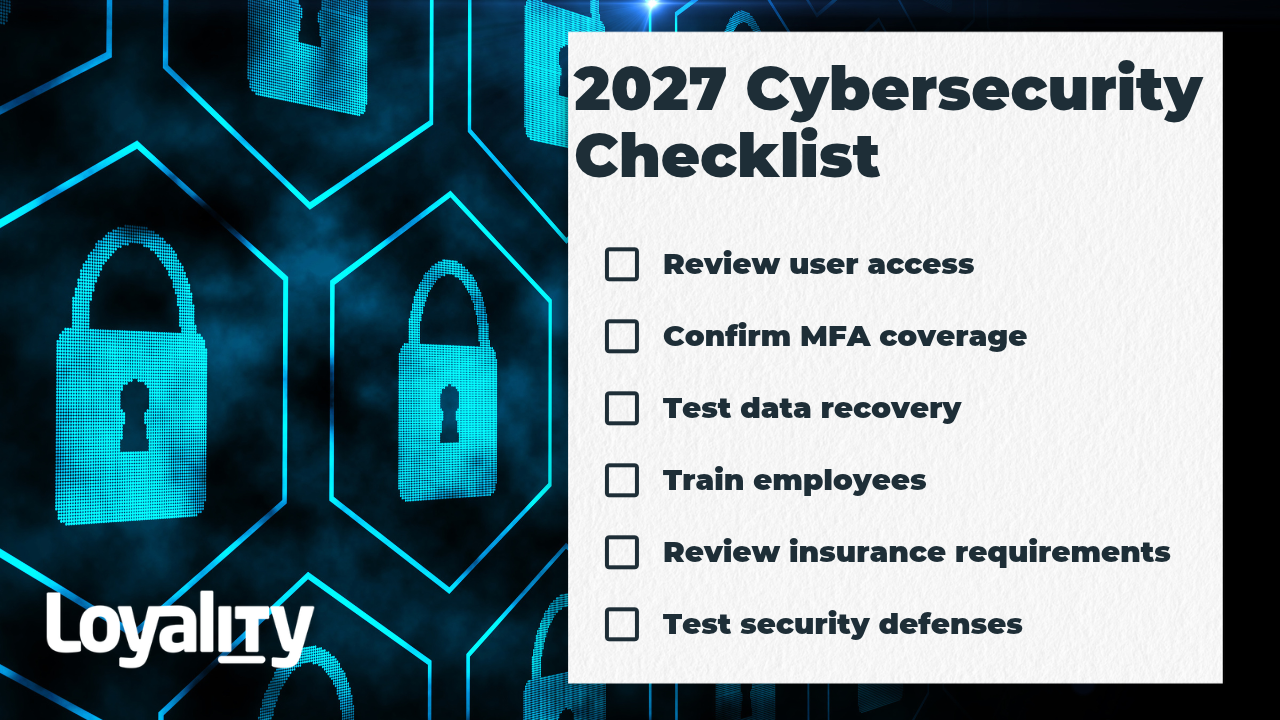
Here are eight priorities to consider adding to your first-quarter cybersecurity checklist.
1. Review Active User Accounts
User accounts are one of the most common entry points into business systems.
Employees join the organization, change positions, take on new responsibilities, and eventually leave. Contractors and vendors may receive temporary access. Test accounts may be created for short-term projects. If these accounts are not reviewed regularly, unnecessary access can accumulate.
Begin the year by reviewing active employee accounts, former employee accounts, contractor and vendor accounts, shared accounts, inactive or rarely used accounts, service and application accounts, and accounts with access to sensitive information.
Any account that is no longer needed should be disabled or removed according to the organization’s policies. Accounts that remain active should have a clear owner and business purpose.
This review can also reveal weaknesses in employee onboarding and offboarding procedures. If former employees still have access or new employees routinely receive more permissions than they need, the process may require improvement.
2. Evaluate Administrative Privileges
Not every employee needs administrative access.
Administrative accounts can install software, change security settings, create users, access sensitive information, and make other significant changes. If one of these accounts is compromised, an attacker may gain extensive control over the organization’s technology environment.
Review which employees, vendors, applications, and service providers have administrative privileges.
Ask whether each individual still needs this level of access, whether employees are using administrative accounts for routine work, whether temporary privileges are being removed after projects end, whether vendor accounts are limited to the systems they support, whether administrative activities are monitored, and whether privileged accounts have stronger authentication requirements.
Access should generally follow the principle of least privilege. This means users receive only the permissions required to perform their responsibilities and no more.
Reducing unnecessary administrative access can limit the damage caused by compromised credentials, malware, or employee mistakes.
3. Confirm Multi-Factor Authentication Coverage
Passwords alone are no longer enough to protect important business systems.
Employees may reuse passwords, fall for phishing messages, or unknowingly expose credentials through compromised websites. Multi-factor authentication adds another layer of verification, making it more difficult for an attacker to access an account with a stolen password.
Many organizations have implemented multi-factor authentication in some areas without applying it consistently across the environment.
Review whether it is enabled for email accounts, cloud applications, remote access, administrative accounts, financial systems, human resources platforms, customer relationship management systems, backup management tools, and vendor and third-party access.
Pay particular attention to privileged accounts and systems containing sensitive data.
It is also important to examine how multi-factor authentication is configured. Employees should understand how to recognize and report unexpected approval requests. Repeated authentication prompts may indicate that someone is attempting to use stolen credentials.
4. Test Backup Restoration and Recovery Procedures
Successful backups are essential, but a completed backup does not automatically mean your organization can recover quickly from a disruption.
A recovery test helps confirm that backup data is complete, accessible, protected, and usable.
Your first-quarter review should determine which systems and data are backed up, how frequently backups occur, where backup copies are stored, whether backups are isolated from production systems, whether ransomware could affect both original data and backup copies, when the last successful restoration test occurred, how long a full recovery would take, which systems need to be restored first, and who would manage the recovery process.
Testing should reflect realistic business needs. Restoring a single file can confirm that the file is available, but it does not necessarily prove that the organization could restore an entire server, application, or business process.
A documented recovery plan should identify critical systems, restoration priorities, responsible individuals, communication procedures, and acceptable downtime.
The objective is not simply to recover data. It is to restore the organization’s ability to operate.
5. Review Email, Cloud, Network, and Server Security
Cybersecurity is most effective when individual protections work together as a coordinated system.
A first-quarter review should examine the major layers of the organization’s technology environment.
Email Security
Email remains a frequent delivery method for phishing, malicious attachments, credential theft, and business email compromise.
Review spam and phishing filters, malicious link and attachment protection, email authentication settings, external sender warnings, mailbox forwarding rules, email backup and retention policies, and procedures for reporting suspicious messages.
Cloud Security
Moving information to the cloud does not automatically make it secure.
Review user permissions, file-sharing settings, guest access, administrative roles, security alerts, inactive accounts, application integrations, and data retention and backup settings.
Network Security
Your network connects employees, devices, applications, servers, and potentially production equipment.
Review firewall rules, remote-access tools, wireless networks, network segmentation, connected devices, vendor access, unsupported network equipment, and monitoring and alerting.
Server Security
Servers may support critical applications, files, databases, and business processes.
Review security updates, supported operating systems, endpoint protection, administrative access, backup coverage, monitoring, unnecessary applications and services, and physical and environmental protections.
The purpose of this review is to identify gaps between layers. An organization may have strong email security but weak cloud permissions, or excellent endpoint protection but excessive vendor access.
Cybersecurity depends on how the pieces work together.
6. Update Employee Cybersecurity Training
Technology can block many threats, but employees still play an important role in protecting the organization.
Cybersecurity training should not be treated as a once-a-year presentation or a policy employees sign and forget. Threats change, and employees need regular opportunities to refresh their knowledge.
First-quarter training could address phishing emails, unexpected login requests, multi-factor authentication fatigue attacks, business email compromise, gift card and payment scams, suspicious file-sharing invitations, password security, safe use of cloud applications, secure remote work, reporting lost or stolen devices, and procedures for reporting suspicious activity.
Training should tell employees what to do, not simply what to avoid.
Employees need to know how to report a suspicious email, who to contact after clicking a questionable link, what to do after entering credentials on an unfamiliar website, how to report an unexpected authentication request, when to verify a financial or sensitive request by phone, and why reporting quickly is more important than hiding a mistake.
A supportive reporting culture is essential. Employees who fear punishment may delay reporting, giving an attacker more time to act.
The goal is not to turn every employee into a cybersecurity expert. It is to help people recognize common warning signs, pause before acting, and report concerns quickly.
7. Review Cyber-Insurance and Compliance Requirements
Cyber-insurance providers, customers, regulators, and business partners are asking organizations to demonstrate stronger cybersecurity practices.
Requirements may include multi-factor authentication, endpoint detection and response, employee cybersecurity training, protected backups, incident-response planning, security monitoring, vulnerability scanning, penetration testing, access controls, and documented cybersecurity policies.
Do not assume the controls documented in an insurance application or customer questionnaire remain fully implemented.
Review your current requirements and confirm that the organization can provide evidence supporting its answers.
Cyber-insurance policies may also include specific notification procedures, approved service providers, or requirements that must be followed after an incident. Leadership and IT personnel should know where the policy is stored and whom to contact.
Organizations subject to PCI, HIPAA, SOC 2, or industry-specific obligations should also determine whether planned assessments, testing, policy reviews, or documentation updates need to occur during the year.
Compliance should not be the only reason to improve cybersecurity, but these requirements can help reveal controls that deserve greater attention.
8. Confirm the Incident-Response Plan
A cybersecurity incident is not the ideal time to determine who should make decisions.
An incident-response plan establishes how the organization will respond to suspected ransomware, unauthorized access, data exposure, compromised email, lost devices, and other security events.
The plan should identify who employees should contact, who is authorized to make critical decisions, how affected systems will be isolated, how evidence will be preserved, when leadership should be notified, when legal counsel should be involved, how the cyber-insurance provider will be contacted, how customers, employees, or regulators may be notified, who will communicate with vendors and outside partners, and how business operations will continue during the response.
Contact information should be available somewhere other than the systems that might become inaccessible during an attack.
The organization should also conduct a tabletop exercise. This is a structured discussion in which participants work through a realistic scenario and explain how they would respond.
A tabletop exercise can uncover unclear responsibilities, outdated contact information, communication gaps, and assumptions that do not hold up under pressure.
Consider Vulnerability Scanning and Penetration Testing
Security reviews can confirm that controls are documented and tools are installed. Testing helps determine whether weaknesses remain.
Vulnerability scanning uses automated tools to identify known vulnerabilities, outdated software, and common configuration problems. It can provide broad visibility across many systems and should be part of ongoing cybersecurity maintenance.
Penetration testing goes further by simulating real-world attack methods and evaluating whether identified weaknesses could be exploited.
Testing may reveal misconfigured security tools, unpatched software, excessive user privileges, weak network segmentation, exposed cloud resources, unsecured vendor access, attack paths created by multiple smaller weaknesses, and security controls that are not working as expected.
The results should help the organization understand which vulnerabilities create the greatest business risk and what should be corrected first.
Testing should not be viewed as an attempt to prove that the IT team has failed. Every technology environment changes, and new risks emerge over time. The purpose is to find weaknesses under controlled conditions, when the organization can address them before an attacker does.
Assign Ownership and Deadlines
A checklist is only useful when someone is responsible for completing it.
Each cybersecurity priority should include a clearly defined action, an assigned owner, a target completion date, required resources, an expected outcome, and a method for confirming completion.
For example, “improve multi-factor authentication” is too broad.
A stronger action item would be: “Review multi-factor authentication coverage for email, remote access, administrative accounts, and financial systems by February 15. Document exceptions and create an implementation plan for uncovered systems.”
Specific actions make it easier for leadership to monitor progress and hold the appropriate people accountable.
Prioritize Risk Instead of Trying to Fix Everything at Once
Most organizations will identify more cybersecurity needs than they can address during one quarter.
That is normal.
Prioritize initiatives according to the sensitivity of the affected data, the importance of the affected system, the likelihood that a weakness could be exploited, the potential operational and financial impact, compliance or insurance deadlines, the time and cost required to correct the issue, and whether other security improvements depend on it.
Start with vulnerabilities that could create the greatest damage or provide broad access to the environment.
Quick improvements can also build momentum. Removing inactive accounts, strengthening administrative access, correcting exposed cloud-sharing settings, and updating contact information may reduce risk without requiring a major project.
The objective is steady, measurable improvement rather than an unrealistic expectation of perfect security.
Turn the Checklist into a Year-Round Cybersecurity Plan
Cybersecurity should not end when the first quarter does.
Use the results of your review to create a roadmap for the remainder of the year. That roadmap might include quarterly access reviews, recurring employee training, regular backup restoration tests, scheduled vulnerability scans, annual penetration testing, security policy updates, incident-response exercises, technology replacement projects, compliance preparation, and cyber-insurance renewal planning.
Cybersecurity becomes more manageable when it is treated as an ongoing business process rather than a series of emergency reactions.
Regular reviews also help the organization adapt as employees, systems, vendors, threats, and business goals change.
Start the Year with Clearer Cybersecurity Priorities
A stronger cybersecurity program does not begin with purchasing every available tool.
It begins with understanding your organization’s risks, confirming that essential protections are working, and assigning responsibility for meaningful improvements.
By reviewing accounts and privileges, confirming multi-factor authentication, testing recovery, evaluating security controls, training employees, examining insurance requirements, testing defenses, and confirming the incident-response plan, your organization can enter the year with greater clarity and confidence.
LoyalITy helps businesses build coordinated cybersecurity defenses across people, processes, and technology. Its cybersecurity services include email security and backup, cloud hardening, network and server defenses, 24/7 Security Operations Center monitoring, dark-web intelligence, employee training, and proactive guidance.
Not sure which cybersecurity priorities should come first? Contact LoyalITy to evaluate your current environment and develop a practical security roadmap for the year ahead.